Introduction: Taking Control of Your Gig Work Taxes
As a gig economy worker for platforms like Uber, DoorDash, or Instacart, you’re your own boss. This means you have the freedom to set your own hours and choose your work, but it also means you’re responsible for managing your own taxes. Navigating tax season can seem daunting, but with proactive planning and a solid understanding of your obligations, you can approach it confidently, maximize your deductions, and keep more of your hard-earned money.
Understanding Your Core Tax Obligations
Self-Employment (SE) Tax
When you work as an independent contractor, you’re subject to Self-Employment tax. This tax covers both the employer and employee portions of Social Security and Medicare taxes. For 2025, the SE tax rate is 15.3% on your net earnings from self-employment, up to a certain income threshold (which is $177,700 for 2025, subject to inflation adjustments). This tax is calculated on your net earnings (your income minus your business expenses) and is in addition to your regular income tax.
Reporting All Income
It is crucial to report all income earned from gig work to the IRS, regardless of whether you receive a 1099-K form. The 1099-K is an informational document, and not receiving one does not exempt your income from taxation. You have a legal obligation to report all income if your net self-employment income is $400 or more. Failure to report income can lead to significant penalties, interest charges, and potentially an IRS audit.
How to Pay Your Taxes: Quarterly vs. Annual Strategies
Quarterly Estimated Payments
The U.S. tax system operates on a “pay-as-you-go” basis. If you expect to owe $1,000 or more in taxes for the year from your gig work (combined across all platforms), you are generally required to make quarterly estimated tax payments. These payments help you avoid a large tax bill at the end of the year and prevent underpayment penalties. The typical due dates for these payments are April 15, June 15, September 15, and January 15 of the following year.
Adjusting W-2 Withholding
If you also have a traditional W-2 job, you can often cover your gig work tax obligations by increasing the tax withholding at your main job. By adjusting your W-4 form with your employer, you can have more taxes withheld from each paycheck. You can use the IRS Tax Withholding Estimator tool to help determine the correct amount to adjust. This can be a simpler alternative to making separate quarterly payments.
Maximizing Your Deductions to Lower Your Tax Bill
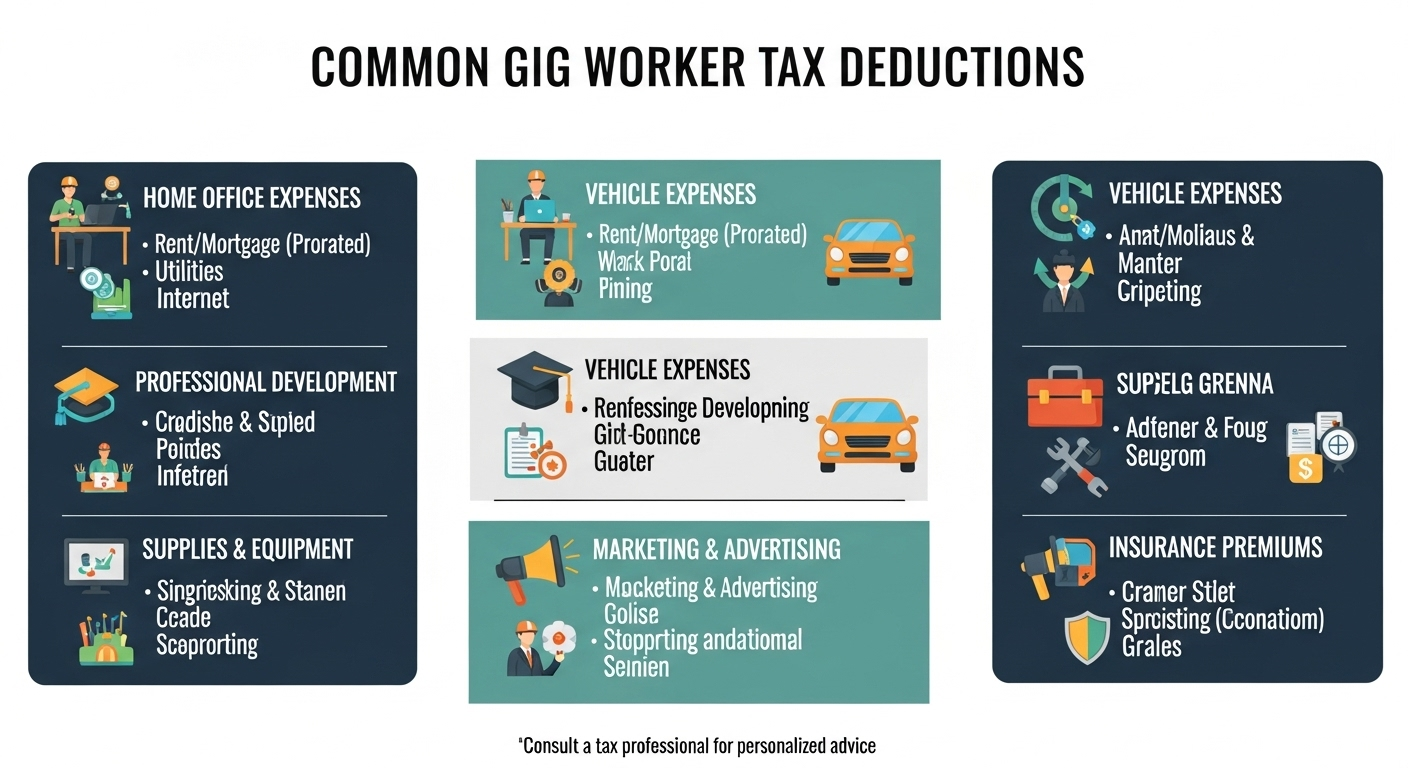
One of the biggest advantages of being a gig worker is the ability to deduct business expenses. These are costs that are “ordinary and necessary” for your work, and they directly reduce your taxable income.
Key Deduction Categories
- Vehicle Expenses (Mileage or Actual Costs)
- Portion of your cell phone bill
- Work-specific supplies (e.g., insulated bags, phone mounts)
- Tolls and parking fees for business trips
- Commissions and fees paid to gig platforms
- Roadside assistance membership costs
Mileage Deduction Calculation
For vehicle expenses, you generally have two options: the Standard Mileage Rate or the Actual Expense Method. For 2025, the standard mileage rate is set at 69 cents per mile. This rate simplifies tracking by covering gas, maintenance, insurance, and depreciation. Alternatively, you can track all actual costs (gas, repairs, insurance, registration, depreciation) and deduct the business-use percentage. The standard mileage rate is often simpler and more beneficial for many gig workers.
It’s crucial to meticulously track your business miles. Business miles start when you leave your home to begin work (e.g., to pick up your first delivery or passenger) and end when you finish your last work activity. Regular commuting miles to a central office are not deductible, but for gig work, turning on your app to accept a job often signifies the start of business activity.

Other Specific Expenses
You can deduct the business-use percentage of your cell phone bills and the cost of the phone itself if used for work. Expenses that are 100% deductible include insulated delivery bags, phone mounts, car cleaning supplies used for business purposes, tolls and parking fees incurred during work trips, and roadside assistance plans.
Tools and Record-Keeping Best Practices
Recommended Software/Apps
To simplify tracking income and expenses, consider using specialized apps. Popular options include Everlance, Stride, and QuickBooks Self-Employed. These tools often feature automatic mileage tracking, receipt scanning, and bank account linking, making it easier to categorize spending, estimate tax liabilities, and maintain a digital audit trail.
Reconstructing Records
If you haven’t been diligent with record-keeping, you can reconstruct your records. Review bank and credit card statements for business purchases, use platform earnings summaries and trip histories for mileage estimates, and check calendars or GPS history. Document the method used for reconstruction. For future years, it’s highly recommended to start using a dedicated tracking app immediately.
Staying Compliant and Avoiding Red Flags
IRS Audit Red Flags
Certain practices can increase your chances of an IRS audit. These include claiming unusually high deductions relative to your income, reporting consistent business losses year after year, using round numbers for expenses, or claiming 100% deduction for assets that are also used for personal reasons (like cell phones). The best defense against an audit is accurate, complete, and contemporaneous record-keeping.
Conclusion: Key Takeaways for a Stress-Free Tax Season
Treating your gig work as a legitimate business is the foundation for successful tax management. Key habits to adopt include diligently reporting all your income, meticulously tracking your miles and expenses, setting aside a portion of your earnings for taxes, and making timely quarterly payments. By staying organized and informed, you can navigate tax season with confidence and keep more of your earnings.
Disclaimer: This article is for informational purposes only and does not constitute professional tax advice. Tax laws are complex and subject to change. The information provided is accurate as of November 14, 2025. You should consult with a qualified tax professional for advice tailored to your specific situation.