1.0 Introduction: The HSA’s Triple-Threat Advantage for Retirement
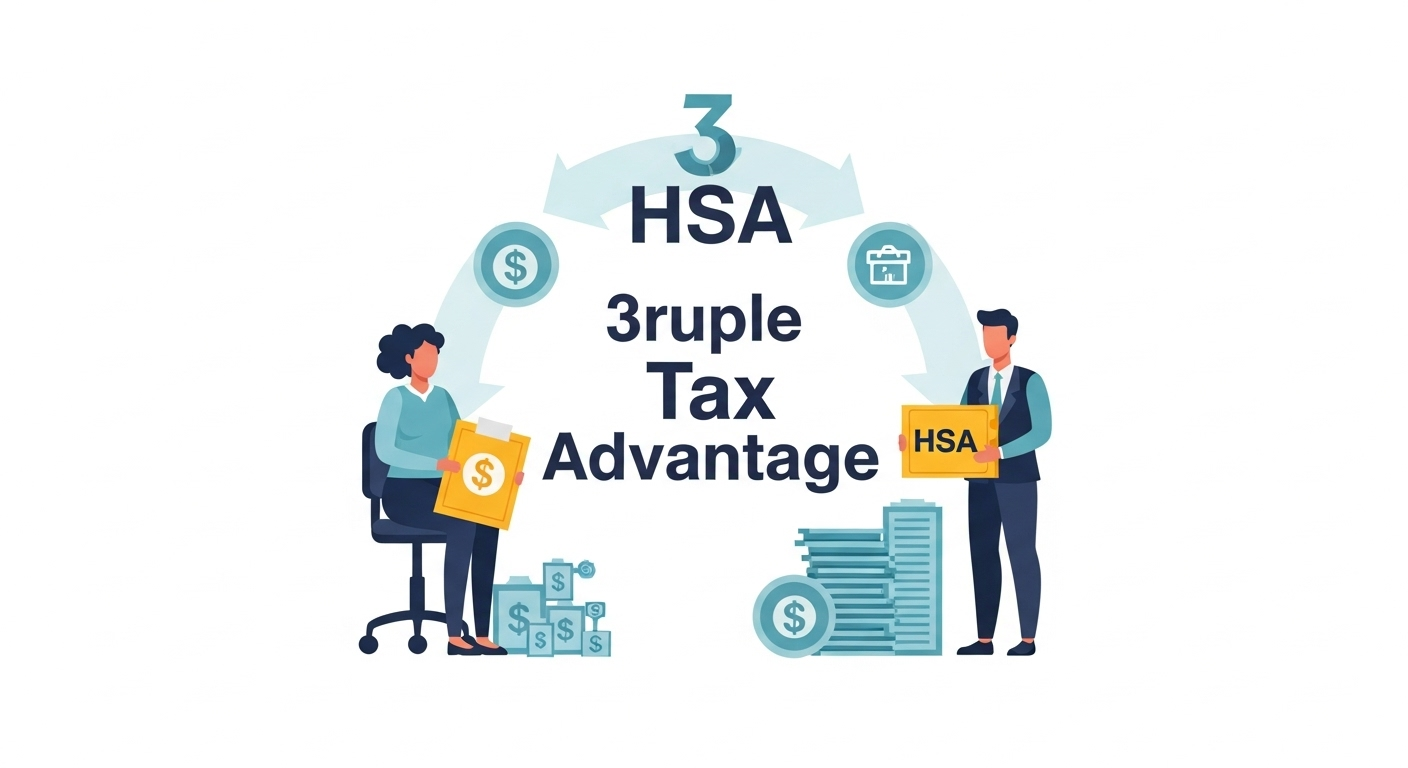
Health Savings Accounts (HSAs) are often misunderstood as solely for current medical expenses but are argued to be the most powerful retirement savings vehicle for Americans. Eligibility requires enrollment in a High-Deductible Health Plan (HDHP). The HSA’s true potential is realized when treated as a long-term investment account. It offers a unique “triple tax advantage”:
- Contributions are tax-deductible.
- Funds grow tax-free.
- Withdrawals for qualified medical expenses are tax-free.
This guide aims to help readers transform their HSA into a cornerstone of financial independence, building a tax-free nest egg for future healthcare costs. The accompanying image below symbolizes the triple tax advantage growing from an HSA piggy bank with a retirement scene.
2.0 Crafting Your HSA Retirement Strategy
Developing a smart strategy for your HSA is key to leveraging its full potential.
2.1 Should I prioritize maxing out my HSA contributions before my 401(k) or IRA?
The optimal strategy follows a specific order for maximizing your retirement savings:
- Contribute to your 401(k) up to the employer match (this is free money with a significant return).
- Max out your HSA contributions (mathematically superior due to the triple tax advantage).
- Max out your Roth IRA.
- Return to your 401(k) until the federal maximum contribution limit is reached.
For more on optimizing your 401(k), refer to Optimizing Your 401(k). The image below illustrates this strategic retirement contribution plan.

2.2 How does an HSA fit into a comprehensive retirement strategy?
Retirement accounts are viewed as specialized tools. 401(k)s and IRAs are primary engines for general living expenses (housing, food, travel). The HSA’s specific mission is to create a dedicated, tax-free fund for healthcare expenses, which can derail retirement plans. Industry estimates suggest a 65-year-old couple may need hundreds of thousands of dollars for retirement medical expenses. A robust HSA acts as a firewall to protect other retirement assets from healthcare costs.
2.3 Is it better to pay for current medical expenses out-of-pocket?
Yes, if affordable, as this “supercharges” the HSA’s growth. Paying with after-tax dollars allows the entire HSA balance to remain invested and compound tax-free. This is referred to as the “shoebox” method: save all receipts for qualified medical expenses. In retirement, one can reimburse themselves from the HSA for the cumulative total, creating a massive, tax-free cash withdrawal. Meticulous record-keeping is essential, including saving digital and physical copies of receipts or Explanation of Benefits (EOBs) detailing date of service, service/product, and amount paid. A spreadsheet is recommended for tracking. For a list of qualified medical expenses, refer to IRS Publication 502.
3.0 Investing Your HSA Funds for Maximum Growth
Treating your HSA as an investment vehicle is crucial for long-term growth.
3.1 What are the best low-fee HSA providers?
Not all HSA providers are equal for investors; employer-sponsored HSAs often have high fees and limited investment options. Look for providers with low administrative fees (ideally $0) and a wide selection of low-cost index funds or ETFs. Fidelity and Lively are cited as examples of investor-friendly platforms. The key is finding an administrator that facilitates easy investment without fees eroding returns.
3.2 What are common investment strategies for an HSA?
Given the long-term growth horizon, HSAs should generally be invested aggressively, similar to 401(k)s or other retirement accounts. A common strategy for younger savers is to allocate 100% to diversified, low-cost stock market index funds (e.g., total stock market index, international stock market index). As retirement approaches, a gradual shift to a more conservative allocation is advised. A primary risk is a market downturn coinciding with a major medical event. To mitigate this risk, it’s wise to keep a portion of the HSA (e.g., one year’s out-of-pocket maximum) in cash or a money market fund as a buffer against selling investments at a loss.
4.0 Using Your HSA in Retirement: Rules and Withdrawals
Understanding the rules for using your HSA in retirement maximizes its benefits.
4.1 When should I stop contributing to my HSA?
Contributions must cease upon enrollment in any part of Medicare, typically at age 65. Prorated contributions are allowed for months of eligibility if Medicare enrollment occurs mid-year. Planning contributions in the years leading up to retirement is important to maximize the balance before this deadline.
4.2 Can I use HSA funds for Medicare premiums?
Yes, this is a significant benefit. After age 65, HSA funds can be used tax-free to pay for Medicare Part B and Part D premiums, and Medicare Advantage plan premiums. This directly reduces fixed income needs in retirement. Medigap (supplemental) premiums are generally not considered qualified expenses.
4.3 What about non-medical withdrawals after age 65?
After age 65, withdrawals for any reason are penalty-free. Non-medical withdrawals are taxed as ordinary income, similar to traditional 401(k) or IRA withdrawals. This feature provides a safety net, acting as a backup traditional retirement account if healthcare costs are lower than anticipated.
4.4 Are there Required Minimum Distributions (RMDs)?
HSAs are not subject to RMDs for the original account owner. Unlike 401(k)s and traditional IRAs, HSAs can continue to grow tax-free throughout the owner’s life. This makes HSAs excellent vehicles for wealth transfer to a spouse or other beneficiary. This aspect is linked to broader financial legacy goals, with a reference to Comprehensive Estate Planning for US Families.
5.0 Conclusion: Your HSA, The Ultimate Retirement Account
By leveraging the triple tax advantage, adopting a long-term investment strategy, and understanding withdrawal rules, the HSA can become a financial powerhouse. It serves as a tool for tax-free medical cost funding, a backup traditional retirement account, and an asset free from RMDs. Readers are encouraged to review their contribution strategy and investment options and treat their HSA with the same seriousness as their 401(k) for a more secure and tax-efficient retirement.
Disclaimer: The information is for educational and informational purposes only and does not constitute financial or tax advice. Consult with a qualified financial advisor or tax professional for individual situations. Content is based on laws and regulations as of November 14, 2025, which are subject to change.